Beatniks

You are currently browsing the archive for the Beatniks category.

img_0500.JPG

Lenny Bruce - American Fantasy Records 7011. Selections recorded in 1960 during nightclub performances in San Francisco.

Liner Notes by Ralph J. Gleason:

If there is one single theme running through the New Comedy of Dissent, it is that an agonizing reappraisal of the priorities of our society is overdue. Artists are on the picket point of all social movements and the jazz men and the satirical creative comics have been the picket points in this country ofthe great social upheaval that has shaken the entire world in the decade following World War II.

Let us not confuse the jazz musicians of the interregnum between the World Wars with the jazz musician now; the attitudes and assumptions are entirely different. The jazzmen of the 30’s, no matter how iconoclastic and no matter how rebellious, accepted as a working base the stereotype his audiences wanted.

The comedians were no less bound by ritual and by rote. World War II broke this and freed the colonial peoples of the world from their concept of subservience and this has been reflected in the jazz musician and it also shook up The Establishment sufficently so that parts slintered off and a reassessment began. Today’s dissent is not based on revising the same order of things but upon a complete re-examination and a completely new approach which abandons the pose and the pretense that had become traditional.

Comedy - especially improvised, creative comedy - bears a strong resemblance to jazz. It is rooted in the same dissent, nurtured in the same rebellion and articulated in the same language in which the priorities of the Establishment have no standing at all.

There is no better example available on record of this entire attitude than Lenny Bruce’s bit on “How to Relax Your Colored Friends at Parties” on this LP.

Done before a mixed audience, the reaction is mixed. Some non-Negroes are outraged either because they think the attitude is outrageous or because they are ashamed to have the truth so bluntly put. Others are momentarily shocked but then, as they see themselves in past moments portrayed on stage they laugh embarrassedly. Others - those few who have escaped from the chains of race to some degree - fall out.

The same spectrum of reaction is followed by the Negroes in the audience. The more courageous and the freer dig it immediately and respond. Then there are those who fear it will rock the boat inhibits them.

Thus it is with Bruce’s humor in many areas. Comedians divide in their reactions. Any of them, from the bland Bob Newhart to the salty Mort Sahl who are themselves based on the same assumptions of paradox and pretense, go down the line with him. Like Charlie Parker, Bruce’s humor is the seminal influence of his generation and a decade from now its effects will be so widespread that those influenced by it may not even be aware of it.

Bruce has already opened up new areas for other comics to explore and it is a testament to the artistic density of the structure of his art that it is so rewarding line by line and concept by concept. Any Bruce show disgorges countless asides and inferences and quick bits that can be expanded (and are being expanded) by others. Bruce has opened the door to a reconsideration of everything in our society except the basic truths of love and beauty and honesty and truth itself. He is, in essence, attacking the whole of our society from the point of view of a street-wise primitive Christian preacher. In other words, he is the child who says the Emperor has no clothes.

There are several other points which are useful to keep in mind when listening to Bruce. He, like the jazz musician, gets bored with the same routines and this has led him to improvisation and leads him now away from things which have become associated with him, making his nightly shows a different experience than his records. He may very possibly do none of the bits on this album any longer. He may probably be bored with them.

The relationship between Bruce and the jazz musicians extends into something else, too. The jazz audience is the basic audience for Bruce because jazz listening postulates familiarity with the feeling of improvisation and this is essential to understanding and appreciating Lenny Bruce. He “wails” like a jazz man, “get in the groove” or whatever he may use to describe the jazz musician’s equivalent of being “on.” You throw away the openings sometimes because he’s just getting started. And when he is in the groove, wailing and on, the whole thing swings in a jazz sense.

One other point. The New Comics, Bruce in particular, establish a very personal relationship with their audience by the simple process of extending their own intimate circle to include the audience. The audience are all personal friends. “I have to read newspapers and see TV shows so I can come back and tell YOU about them,” Bruce remarks to the audience. His entire attitude is that of the gifted commentator in the personal circle telling all his friendsabout the incredible examples of life and social behaviour he has encountered in the recent past. He does not tell jokes. He does bits and he does routines, but he also tells them directly to YOU. This is both the secret of the successand the failure of this form of the comic art. But at its best, it is somethingmore vital and alive than anything except the very best in art. Some excerpts of that order are included here.

insomnia.bmp

Mario Albanese “Insonia” (”Insomnia”). Odeon from Brazil (1959). Courtesy of LP cover lover Desiderio (Julio Siveira). Loronix has this posted with a link to download the music! Check it out.

Basket case

sickhumor.jpg

“The Sick Humor of Lenny Bruce” Fantasy Records (1958) Thanks to Steve Talley for sending this in!

The Liner Notes: We are living in a culture of conformity, the sociologists keep telling us as they pore over statistics that indicate college students are conservative this year. That may be. But sometimes it seems as if the sociologists miss a few points such as Bob and Ray, jazz musicians and the well-honed wit that is bringing the Comedy of Dissent these nights to various clubs in the person of Lenny Bruce.Lenny Bruce is an example of something new in our society. He’s a comic right out of the jazz world. Unlike Mort Sahl, himself a razor wit flavored with a liberal dose of jazz orientation but self-confined to a political and national affairs horizon with forays into a limited social strata bounded on one side by hi-fi and on the other by the psychiatrist’s couch, Lenny Bruce ranges throughout our society. Armed with the anarchistic wit and salty speech of the jazz musician, Bruce does his satirical bits in a multitude of voices as contrasted to Sahl who is a stark, stand-up comic monologist.

Bruce’s whole orientation is that of the jazz musician and knowing this is fundamental to understanding and appreciating Bruce’s humor. Like the jazz musician’s view, Bruce’s comedy isa dissent from a world gone mad. To him nothing is sacred except the ultimate truths of love and beauty and moral goodness - all equating honesty. And like a jazz musician he expects to see these things about him in the world in a pure form. He takes people literally and what they say literally and by the use of his searing imagination and tongue of fire, he contrasts what they say with what they do. And he does this with the sardonic shoulder-shrug of the jazz man.

He is colossally irreverant - like a jazz musician. His stock in trade is to violate the taboos out loud and to say things on stage (and on this LP) which would get your nose bashed in at a party. But his outrage at society is not represented by shrill screams or loud protests. He does not pose. His is a moral outrage and has about it the air of a jazz man. It is strong stuff - like jazz, and it is akin to the point of view of Nelson Algren and Lawerence Ferlinghetti as well as to Charlie Parker and Lester Young.

Bruce improvises the way a jazz musician does. His routines on this album, for instance, are never done the same way twice but move like a soloist improvising on a framework of chords and melody. He takes a hard look at middle-class America with its Babbitts, its Lodges, and its Elmer Gantrys. He stabs the motion picture business with brutal parody and he punctures the hypocrisy in religion, politics, and other areas with an arrowtipped with poison.

Lenny Bruce is a social commentator, as is the jazz musician. It is an interesting point for speculation as to why his comedy of dissent has flourished in the jazz clubs. He terrifies other comics - the usual ones - by his material, in the same way the jazz musician terrifies the hotel bands and the mickey mouse tenor men. He is a threat. If he is real, he gives them the lie by his very existence.

For almost two decades the night clubs have wallowed in a sea of sentimentality and pious corn and bathroom jokes. That’s why Joe E. Lewis is such a relief. He is real and so is Lenny Bruce.

The jazz musician is a rebel with humor, if with a cause, and there is no more effective putdown of the political speeches, the incongruities in the news, the fetuous posing of the tent show religious carnivals than that which goes on in the conversation of the jazz musician and the humor of Lenny Bruce.

It’s ribald. Yes, and even sometimes rough. But it’s real. You have to earn the respect of the jazz musician, he doesn’t give it because he’s told to. And this attitude, a modern manifestation of the original American “show me,” is Bruce’s strength. He’s a verbal Hieronymus Bosh in whose monologue there is the same urgency as in a Charlie Parker chorus and the same sardonic vitality in his comments as in Lester Young’s reflections on a syrupy pop tune.

The jazzman may be anti-verbal, as Kenneth Rexroth says, if so, he has Lenny Bruce to speak for him with power.

- Ralph Gleason

ejn51833.jpg

The New Beat Generation by Bernt Rosengren.

img_4161.JPG

I love the recordings of Kerouac reading his works. He has a great voice and very cool, laid back style. Here’s a clip of him on the Tonight Show with Steve Allen on the piano.

Verve Records 1959. Cover photo of Kerouac by Robert Frank. Sleeve notes by Bill Randle. Kerouac reads extracts from “Old Angel Midnight”, “Desolation Angels”, “The Beginnings of Bop”, “Mexico City Blues”, “Neal And The Three Stooges”, “San Francisco Blues”, “The Subterraneans” and more. Unlike Jack’s previous two lps this one is him solo. Without Steve Allen on the piano or Zoot Sims on sax.

img_4144.JPG

Anything on Dig Records is cool.  “Wiggin with Wig” The Gerald Wiggin’s Trio.  I think Johnny Otis started the Dig Label and he’s the producer here.

img_4046.JPG

Kenneth Rexroth organized and emceed the legendary Six Gallery reading on October 7, 1955, at which Ginsberg introduced the world to “Howl”. Rexroth’s work was composed with attention to musical traditions and he performed his poems with jazz musicians. Nonetheless, Rexroth was not wholly supportive of the dramatic rise in popularity of the so-called “Beat Generation,” and he was distinctly displeased when he became known as the father of the Beats.

A life-long iconoclast, Rexroth railed against the dominance of the east-coast “literary establishment” and bourgeois taste that was corrupting American poetry. While he refused to consider himself a Beat poet, his influence as champion of anti-establishment literature paved the way for others to write poems of social consciousness and passionate political engagement. His greatest contribution to American poetry may have been in opening it to Asian influences through his mystical, erotically charged poetry and superb translations. Kenneth Rexroth died in 1982 at 77 and is buried in Santa Barbara on a cliff above the sea.

Read more about Kenneth Rexroth at Modern American Poetry.

img_4048.JPG

Beatific

img_4098.JPG

img_3919.JPG

The Nutty Squirrels.  Created and produced by Sascha Burland and Don Elliott.  Hanover Records.  “Salt Peanuts”  1959.

img_3862.JPG

#4 in a cool series of jazz compilations put out by the Dawn label. All with great covers, this is the best though. What style! The classic Lambretta, the babe, the tight pants and low cut top! The music is equally good and deserving of the hip sleeve. The roster includes Paul Quinichette, Nat Pierce, Gene Roland, Ed Thigpen and Earl May.

img_3854.JPG

I don’t remember where I picked this record up, but it’s signed by the man himself. It’s scribbled: “To Princess Marge the beauty. May you swing with love. Love Lord Buckley.”

“Way Out Humor” on World Pacific Records. Royal Concert Performance Ivar Theater Hollywood (1959)

Lord Buckley died in 1960. I recommend you dig him a bit deeper! There are some cool clips of LB on youtube including his appearance on “You Bet Your Life” with Groucho from 1956. Remarkable.

img_3852.JPG

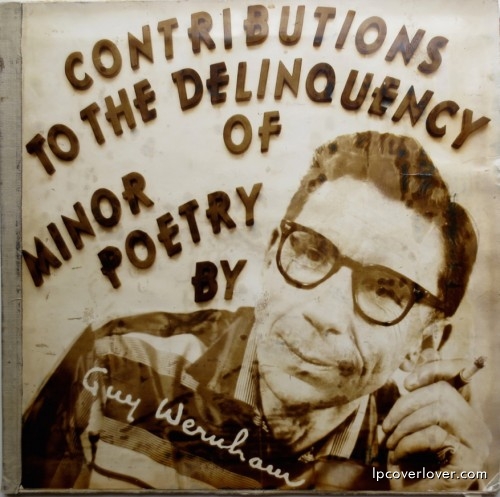
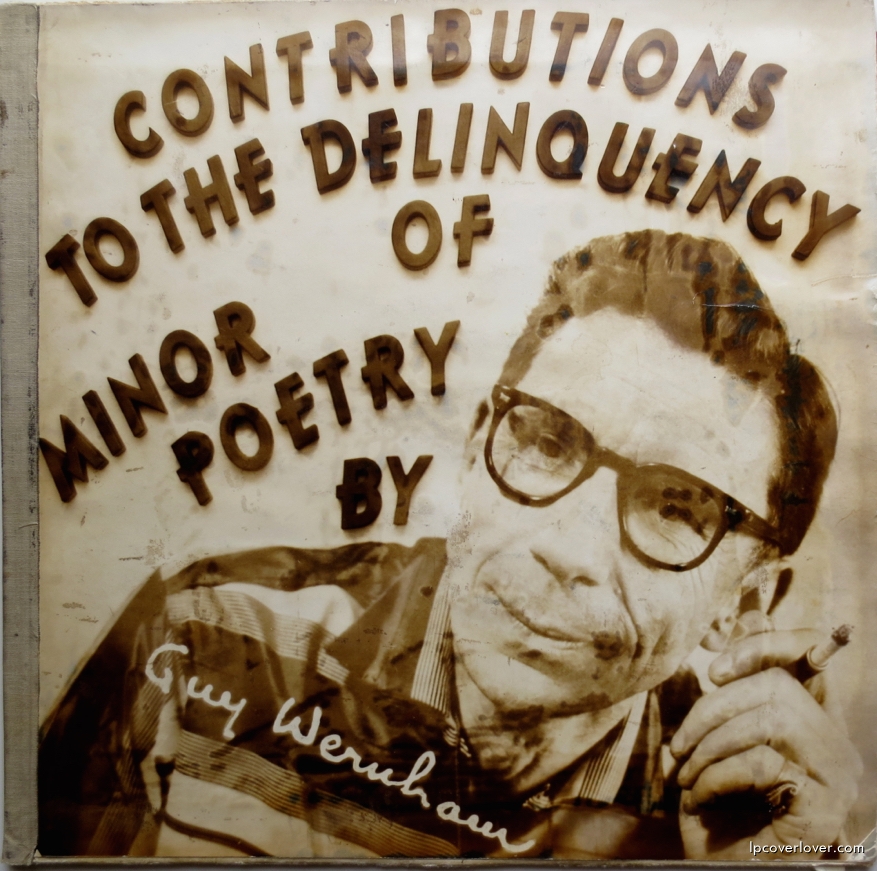
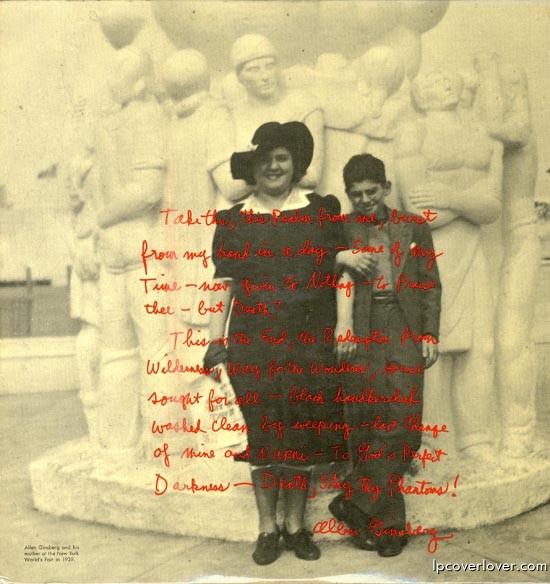
An odd piece of beatnik poetry from 1957. “Contributions to the Delinquency of Minor Poetry by Guy Wernham” I never heard of this guy, but a Google search brought up his name as a dude on the San Francisco scene who first made his name with a 1943 translation of Lautremont’s “Les Chants du Maldoror” in New Directions magazine. It says by the mid-50’s he was tending bar in North Beach and a frequent visitor to Alan Ginsburg’s apartment. The cover is pretty unusual and cool I think. Can’t be many of these around.

lpmikamitakeshi-576_1.jpg

One of my favorite covers and one of my favorite saxophonists (and on this session with one of my favorite piano players). Go Man! It’s “Sonny Criss” and Modern Jazz Imperial Records. Sonny Criss (as) Sonny Clark (p) Leroy Vinnegar (b) Lawrence Marable (d) Los Angeles, CA, July 10, 1956 (No, that’s not Criss on the motorbike)

wv12mono-153.jpg

I’ve always loved this cover and title! I’ve seen Ralph Sharon accompany Tony Bennett a half dozen times, the most memorable being opening night of the Newport Jazz Festival 1990 or 1991. The gala concert and party was held at the Tennis Hall of Fame and I sat at the side of the stage with Ossie Davis and Ruby Dee. Perhaps also aptly Mr. and Mrs. Jazz.

Sue and Ralph Sharon “Mr. & Mrs. Jazz” Bethlehem

J.R. Monterose (ts) Eddie Costa (vib) Ralph Sharon (p, vo) Joe Puma (g) Milt Hinton (b) Jo Jones (d) Sue Ryan (vo ) NYC, November, 1956 1. It Don’t Mean A Thing 2. A Fine Romance 3. I Could Have Told You 4. Mynah Lament 5. Just You, Just Me 6. That Goldblatt Magic 7. A Nightingale Can Sing The Blues 8. Hugette Waltz 9. A Trout No Doubt 10. With The Wind And The Rain

lp09-big.jpg

Fink Along with Mad.  BigTop Records.  “12 More Laughable, Danceable, Singable Newbies - But Kookies.”  Including:  “Let’s Do the Fink”; “She Lets Me Watch Her Mom and Pop Fight”; “Don’t Put Onions On Your Hamburger”; ” When the Braces On Our Teeth Lock”; “Loving a Siamese Twin”; “I Accidentally Messed Up His Hair”; “I’ll Never Make Fun of Her Mustache Again”; “The Neighborhood Draft Board”; and “The Biggest Mouth In Town”.

img_3257.JPG

Columbia UK soundtrack to the 1960 British film “Beat Girl”
The title character is played by starlet Gillian Hills, who later went on to have numerous small roles in 1960s and 1970s films, such as Blowup and A Clockwork Orange.

The music was done by a seven-player group of John Barry, composer of James Bond fame. The film also features Christopher Lee as a strip-joint operator, and the film debuts of Adam Faith and Peter McEnery.

st-wolfman1.jpg

img_1139.JPG

This is one of my rarest and most valuable records. It is an alternate cover that was recalled by conservative Dot records owner Randy Wood when he realized who Jack Kerouac was and felt that the beat poet’s counter-cultural subject material was too offensive for his Pat Boone and Shirley Jones-loving consumers. (About 100 copies got out to radio stations before the recall.) The record was cut in a single session and a single take for each piece which certainly supported Jack’s first draft is best draft philosophy of writing.

This is the first of Kerouac’s three records and is the result of a performance at the Village Vanguard with Steve Allen accompanying him on piano. The album was produced by Bob Thiele who then left the company over the dispute, took the master tape and formed Hanover Records with Steve Allen. Hanover then released the record in 1959.

img_1068.JPG

Jazzbo Collins tells fairy tales to put hip kids to bed.  Dig-arooni?

« Older entries

Categories

  • Blogroll