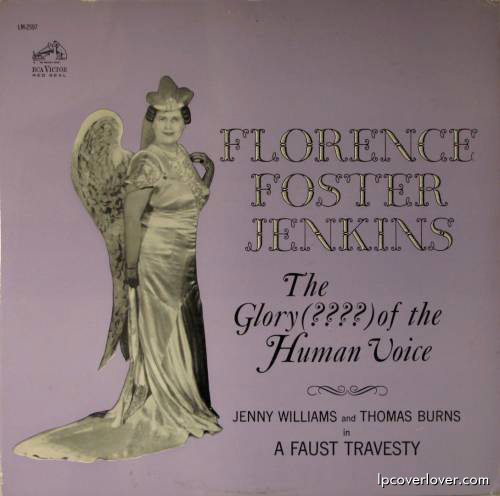
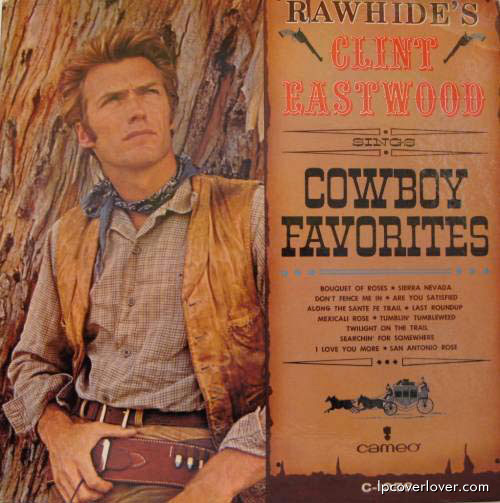
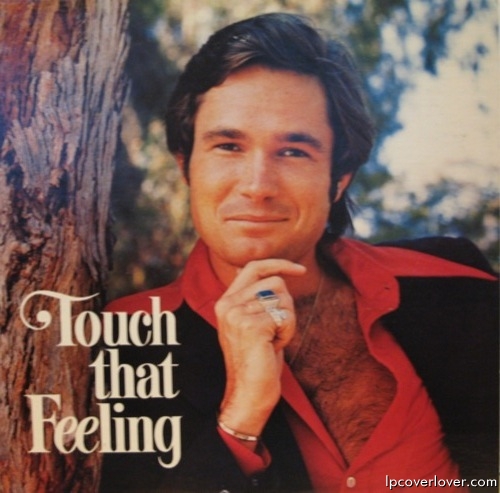
“The Glory (????) of the Human Voice” “A Faust Travesty” RCA Records. Ms. Jenkins was a wealthy benefactor to the arts in the first half of the twentieth century. She fancied herself an opera singer despite her complete lack of talent, pitch or range. Never-the-less she performed and recorded with the utmost earnesty for friends and family. She even went so far as to rent out Carnegie Hall and a full orchestra to perform with. How or why RCA got involved, I have no idea. Check her out on youtube. Someone wrote that David Bowie is a fan of this record.
You are currently browsing the archive for the Golden Throats category.
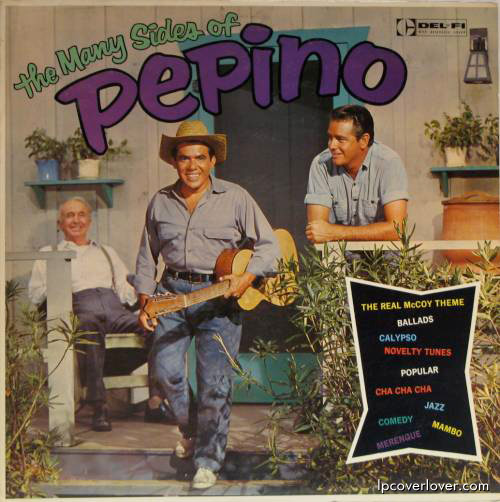
“The Many Sides of Pepino” — Tony Martinez (1920-2002) on Del-Fi Records. Here’s the singing debut of Pepino from the popular TV show “The Real McCoys”. On ABC from 1957 -1963. Starring Joan Blondell (”A Tree Grows In Brooklyn), Walter Brennan (Three Oscars for Best Supporting Actor), Richard Crenna (”Our Miss Brooks”), Kathleen Nolan, Butch Patrick (soon to become Eddie Munster) and Tony Martinez (above) as “Pepino”.
This show predates my TV days and I don’t think I even saw the reruns. I’m kinda sorry I missed it.
King Henry the Fifth / Elegy for the Brave / Theme from Cyrano / Mr. Tamborine Man/ Hamlet / It Was a Very Good Year / Romeo and Juliet / How Insensitive (Insensatez) / Spleen / Lucy In the Sky With Diamonds / The Transformed Man
The Transformed Man is actor William Shatner’s debut album, released in 1968, while the original Star Trek series, in which he starred as Captain James T. Kirk, was still on the air. The album is best remembered for showcasing Shatner’s now-famous vocal style— spoken word - with a number of dramatic pauses and flourishes and some of these performance are stand outs on the Rhino Recrods’ “Golden Throat” series.
Shatner’s first album The Transformed Man still stands as a classic in the “novelty / celebrity camp” department and deservedly so, as listening to this album is an utterly perplexing experience. If the quality of an album would be measured by how loud the listener yells “WHAT THE FUCK IS THIS?” while hearing it for the first time, then this album would be one of the most impressive ones to ever appear on this website. Many celebrities - mainly actors, the vain breed - have recorded and released music (ever heard Leonard Nimoy, Don Johnson and Bruce Willis?), but no one did it with as much conviction, insanity and hubris as good ole Captain Kirk of Star Trek. Not even David “I’ve been looking for freedom (and found it on a beach)” Hasselhoff, who by all accounts is a bad-ass motherfucker you don’t wanna mess with.
In the totally serious liner notes, Shatner tells you how the project came to be and how he’d always had the ambition to do “something with the spoken word combined with the magic of music.” Ideas actually turned into plans, the “right” people got together and Shatner did get his record… which consisted of parts of Shakespeare (”Henry the Fifth,” “Hamlet” and “Romeo and Juliet”) and poems by Frank Devenport set to music, as well as reinterpretations of Dylan’s “Mr. Tambourine Man” and The Beatles’ “Lucy in the Sky with Diamonds.” And the results… they’re astounding, bigger than life mini-operas that somehow managed to combine ultra-expressive and loud music (Stravinsky-meets-Bernard Herrmann!) with Shatner’s hilarious spoken word-parts. Of course, he’d already had some experience with the clumsy dialogue of the Star Trek series, but here he easily surpasses himself and turns in classic performances that are so mannered, pompous and theatrical that you just don’t know whether he’s serious or messing around with whoever was/is stupid enough to listen.
During “Henry the Fifth,” he delivers an impressively fiery speech inciting an army to fight, while the love-story of “Romeo and Juliet” is told as if he’s telling a few 4 year-olds about Bambi and the baby Jesus. The music in the meantime usually adapts itself to the vocals. One moment, your speakers will be terrorized by militaristic salvos and grotesque crescendos, the next moment (”Elegy for the Brave”) it transforms into a kind of slick, campy lounge that could be used for a French soft-porn flic. Nothing is held back: harps, bassoons, sudden trumpet interruptions, ringing sleigh bells, flutes, tension-creating percussion - it all serves to create an effect that’s as artificial as Shatner’s art. It never really works though, as the man’s intonation and (unintentional?) sense of humour steal the show over and over again. Just check out how he starts saying “Mr. Tambourine Man… hey, Mr. Tambourine Man… hey, Mr. Tambourine Man???” while some idiot is beating himself to a pulp with a tambourine. It’s classic material. Even better - although you could also call it a gruesome massacre as well - is the total demolition of “Lucy in the Sky with Diamonds,” where the Cap’ goes into realms of overacting where no one ever went before. It’s embarrassing and mind-boggling, but also good for a few laughs, although I wonder what The Beatles actually thought at the time. Because of their popularity and the treatment they’re given, the popular songs are the most interesting here, although the closing track (according to the liner notes a three-movement form: “earthly unreality - transitional awareness - contract with divinity”) is also worth a few listens. Because of its bizarre portentousness and Shatner’s side-splitting approach, it works much better as comedy than music, but it’s also extremely cool to file The Transformed Man between Del Shannon and The Shirelles. Or Saxon and Slayer, if you’re into a different style of music. — Guy Peters
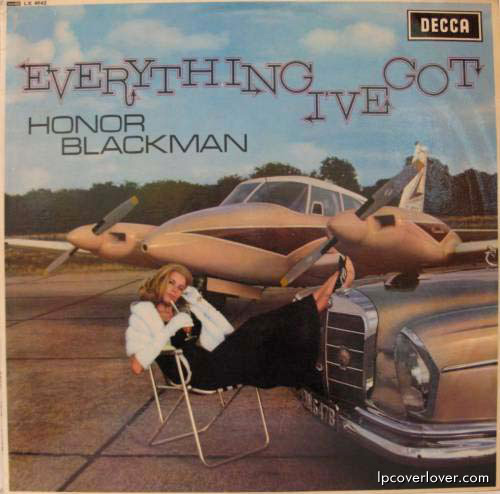
Honor Blackman was the British actress that will be forever known for playing the character Pussy Galore in the James Bond movie “Goldfinger” in 1964.
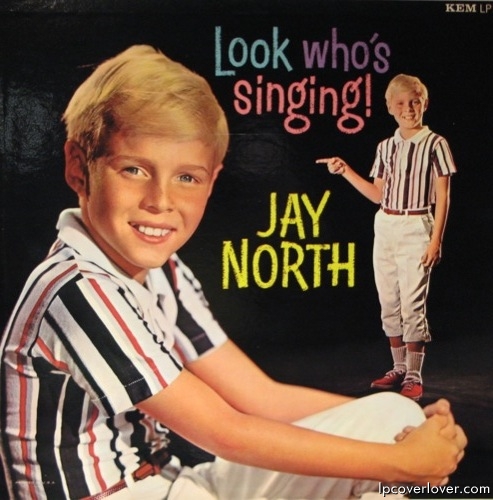
Jay North, aka Dennis the Menace, the quintessential rascal next door, gets his chance to cut a record. Hey it worked for Ricky Nelson. This is not music from the series, in fact I don’t know any of these songs (e.g., When I become a man, What good is a girl).
The liner notes say: “This album is for you…if you are a child…if you have a child…if you know a child…or if you ever were a child.” It still didn’t sell.
This is the 1959 CBS live-action situation comedy based on the comic strip by Hank Ketcham. Dennis is portrayed as the helpful menace that always seemed to cause chaos. Dennis Mitchell lived at 627 Elm Street with his parents, Henry and Alice. Next door was his best friend, Mr. Wilson (though the feeling was, certainly, not mutual). Dennis always was around to help Mr. Wilson whether he wanted the help or not. The allure of the series was to see how Dennis would unintentionally mess things up for Mr. Wilson.
The series lasted four seasons, but, perhaps, could have lasted longer. Joseph Kearns, the actor who portrayed Mr. George Wilson, died during the show’s third season. This left a huge void that even veteran actor Gale Gordon (Mr. John Wilson) couldn’t fill. He was introduced toward the end of the third season, and the series was cancelled the following year.
Theme Song “Dennis the Menace” by Irving Friedman
First Telecast : October 4, 1959
Last Telecast : July 7, 1963
Episodes : 146 black-and-white episodes
CBS Sundays —- 7:30 - 8:00 P.M.
Courtesy of TV.com
Before he was whacking guys in the desert or stabbing them with their own pen, Joe Pesce took a stab at a singing career. I’m not going to say anything about it, cause you never know, but I’m glad he starting acting. What I make you laugh? I amuse you?
The liner notes compare Joe Ritchie (a temporary stage name) to Little Jimmy Scott. Scott’s influence was noted by Jack Lewis (Brunswick producer) and Monte Kay (of the Modern Jazz Quartet) when Joe played with jazz sax legend Willis “Gator” Jackson at the Palm Garden in Harlem. (Turns out, according to the liner notes, that Joe lived briefly with Little Jimmy Scott in Chicago!)
Joe sings the Beatles’ “Got to get you into my life,” “The Fool on the Hill,” and “Fixing a hole” (think Casino!). Also three Bee Gees compositions, “Holiday,” “To love somebody,” and “And the sun will shine”. This on Brunswick, the soul label that was home to Jackie Wilson, Tyrone Davis, Barbara Acklin, the Chi-lites and others.
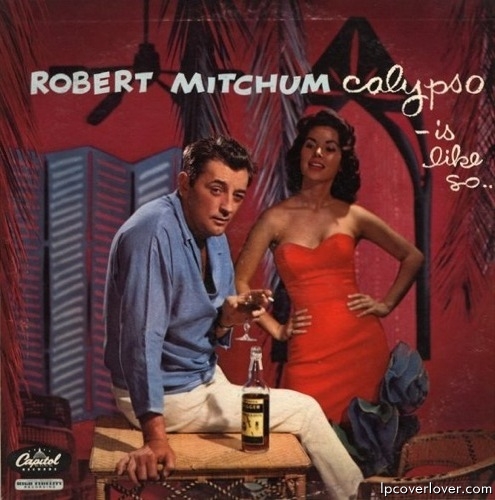
Calypso Is Like So…..CooL, just like Robert Mitchum, the actor whose famous leer graced the film noir classics, “Crossfire” and “Cape Fear” , and who portaryed the hauntingly evil preacher in the surreal film classic, “Night Of The Hunter”. In the mid-fifties Mitchum was sent to Trinidad to film on location and wound up staying there for ten months, soaking up the culture and listening to calypsonians such as Lord Melody and Mighty Sparrow perform live. He returned to the US, singing the praises of calypso music, a style which had already been embraced by white America due to the recent popularity of Harry Belafonte. In 1956, Mitchum released this lp on RCA. Unfortunately, the label censors did not permit Mitchum to use the risque lyrics and double entendres that provide humor and zest to calypso music. Nevertheless, Mitchum employed the lyrical style of the music to great effect . While the lp contains some tame and lame versions of calypso standards, his take on “Tic ,Tic, Tic” and “Mama Look Boo Boo” capture the cool essence that was Robert Mitchum.
In 1948, actress Lila Leeds and actor Robert Mitchum were arrested for marijuana possession. The public had sympathy for him, and he went on to a great career. Leeds, on the other hand, struggled after getting out of jail, was introduced to heroin use while in jail and became a full-blown addict afterwards. She was last heard from working in a drug rehabilitation facility in the mid-1970s.
An “incredibly strange” record and example of the celebrity “Golden Throats” series that has washed up stars taking on the hits of the day to usually disasterous or “so bad, it’s good” effect. This one is on Tower records, which put out some cool sixties rock and roll and some biker and surf soundtracks and the group isn’t bad musically. “Day Tripper” is a classic.


Recent Comments