Welcome to the weird and wonderful world of record covers from the golden age of LPs


Subscribe to feed Follow us on Twitter Follow us on Tumblr

Poetry

You are currently browsing the archive for the Poetry category.

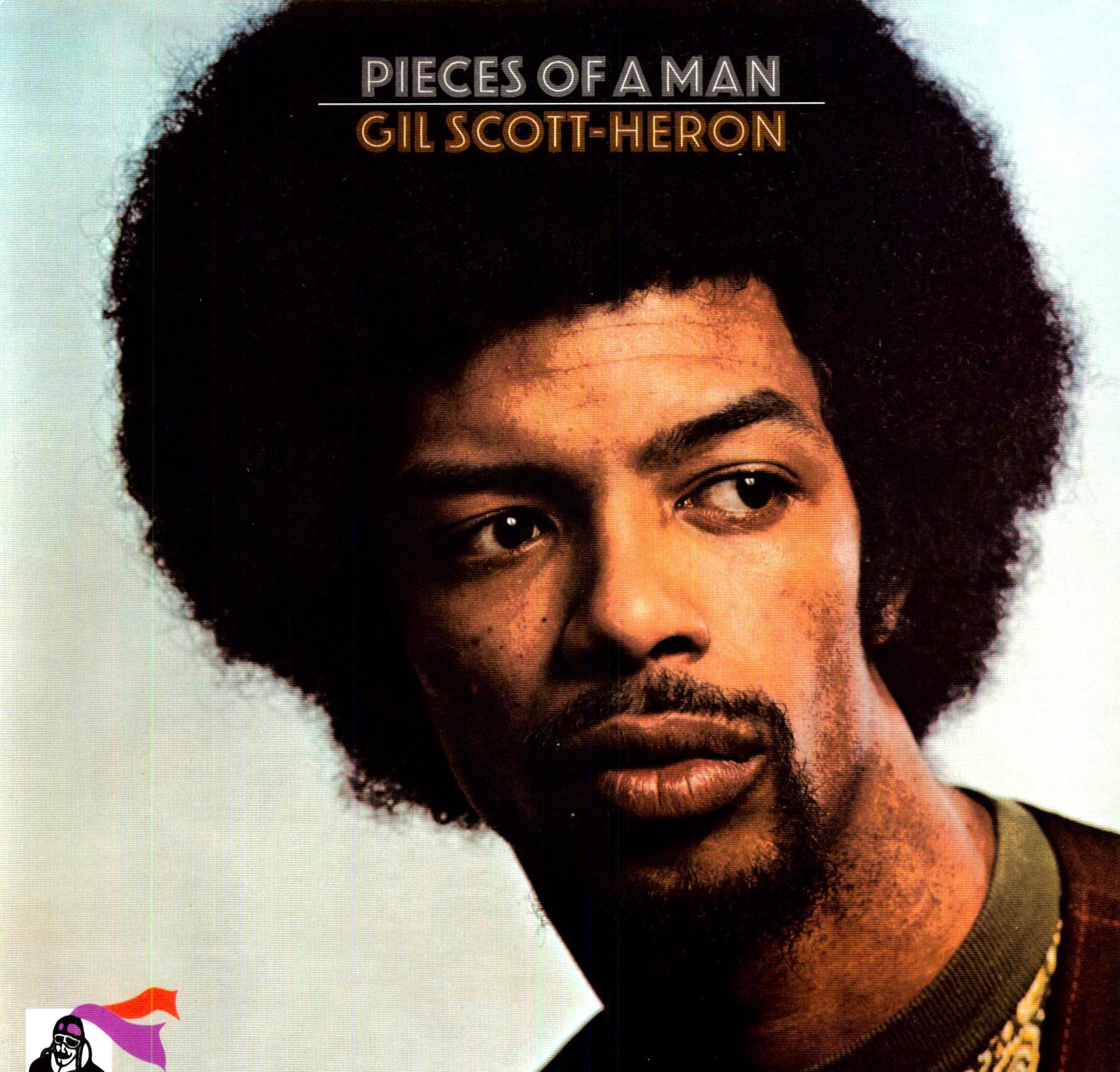
RIP Gil Scott-Heron

Gil Scott-Heron   (April 1, 1949 – May 27, 2011)

“Pieces of a Man”   Flying Dutchman Records (1971)   With Brian Jackson, Ron Carter, “Pretty” Purdie, Burt Jones, and Hubert Laws   Including The Revolution Will Not Be Televised, Save The Children, Lady Day And John Coltrane, Home Is Where The Hatred Is, Pieces Of A Man and the beautiful “I Think I’ll Call It Morning”

1 Star2 Stars3 Stars4 Stars5 Stars (40 votes, average: 3.58 out of 5)
Loading ... Loading ...

Outer Burroughs

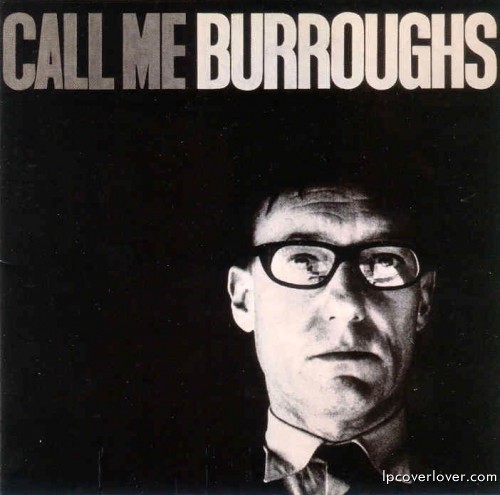
CALL ME BURROUGHS (ESP-Disk)   Recorded in his instantly recognizable, craggy and clipped mid-western drawl at the English Bookshop, Paris, France in 1965.   This first recording by poet, novelist and Beat legend William S. Burroughs includes excerpts from his novels NAKED LUNCH, NOVA EXPRESS and THE SOFT MACHINE.   In the Seventies and Eighties, Burroughs recorded a number of solo projects, in addition to collaborating with everyone from John Cale and Laurie Anderson to Tom Waits and Kurt Cobain.

“The excerpts follow the exploits of junkies, prostitutes, doctors, and others as they move through grisly underworlds without concern for the borders between reality and hallucination. By turns, they are blackly funny and deeply sinister, often within the same piece.”

1 Star2 Stars3 Stars4 Stars5 Stars (42 votes, average: 3.81 out of 5)
Loading ... Loading ...

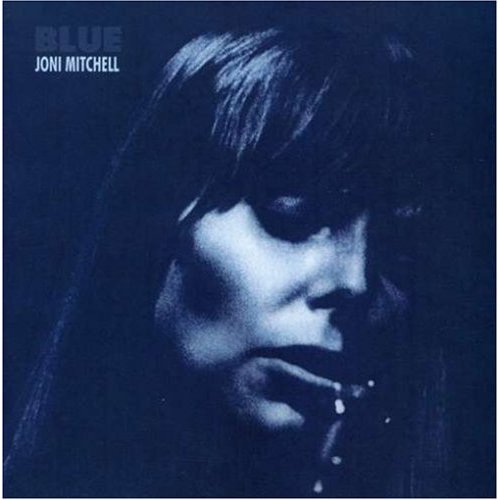
True Blue

Blue   Joni Mitchell   (1971)   This one is timeless and beautiful.   So personal and so universal.

1 Star2 Stars3 Stars4 Stars5 Stars (50 votes, average: 3.88 out of 5)
Loading ... Loading ...

Leave it to the prose

IMG_4315

“Cool Prose For Kats”   Ric Records

1 Star2 Stars3 Stars4 Stars5 Stars (31 votes, average: 3.84 out of 5)
Loading ... Loading ...

Pimp laureate

Iceberg Slim “Reflections” (1976) ALA Records. Producer: David Drozen; Executive producer: Louis Drozen; Photography: Robert Wotherspoon. Former Chicago pimp and convict, Slim (Robert Beck) reformed and became a published and celebrated author with his first autobiography, PIMP, The Story of My Life in 1969.   Slim passed away in 1992 at the age of 73. Rappers Ice Cube and Ice T, both cite Slim as the inspiration for their names.

With his polished delivery and smooth, almost soothing voice, Iceberg Slim could have been one of any number of beatnik poets, delivering elaborate monologues over smooth background music on 1976′s Reflections. The difference is Iceberg Slim (neé Robert Beck) was a pimp, and his stories are scathingly explicit, and, more often than not, extraordinarily compelling. The language can get graphic; this is not an album for the squeamish. For those who aren’t easily offended, though, this album will be spellbinding. Slim’s skills as a storyteller cannot be overstated; even at his crudest, he still spins riveting yarns. “The Fall” is virtually autobiographical, depicting his last days as a pimp and what sent him on a downfall to prison, leavened with scabrous humor.

“Broadway Sam” is a mean, hilarious story of another pimp who has the tables turned on him in prison. The second half of the record, though, is more poignant, as Slim remembers a lost love on “Durealla” and comes to terms with his relationship with his late mother on “Mama Debt.” Throughout the record, Slim is backed by jazzy music courtesy of the Red Holloway Quartet, which enhances the stories without overshadowing them. Many years later, of course, Slim would serve as the inspiration for gangsta rappers like Ice-T (who named himself after Slim) and Schoolly D. Too many of Slim’s followers, though, lack the mixture of street smarts and the intellectual and emotional depth shown here. For anyone interested in the roots of modern urban culture, Reflections is a must-hear. – Victor W. Valdivia, All Music Guide

1 Star2 Stars3 Stars4 Stars5 Stars (33 votes, average: 3.09 out of 5)
Loading ... Loading ...

Village voices

img_1475.jpg

img_1477.jpg

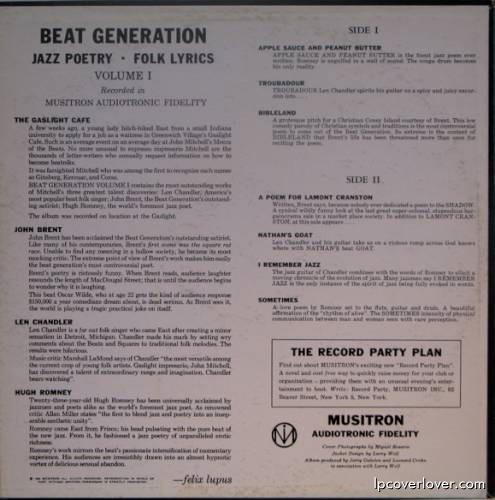
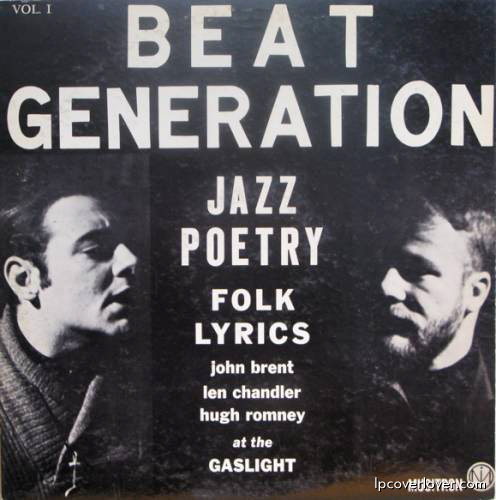
“Beat Generation” Jazz Poetry. Folk Lyrics. John Brent, Len Chandler and Hugh Romney at the Gaslight, Greenwich Village. Musitron Records.

1 Star2 Stars3 Stars4 Stars5 Stars (26 votes, average: 3.62 out of 5)
Loading ... Loading ...
Tell it like it is

img_1536.JPG

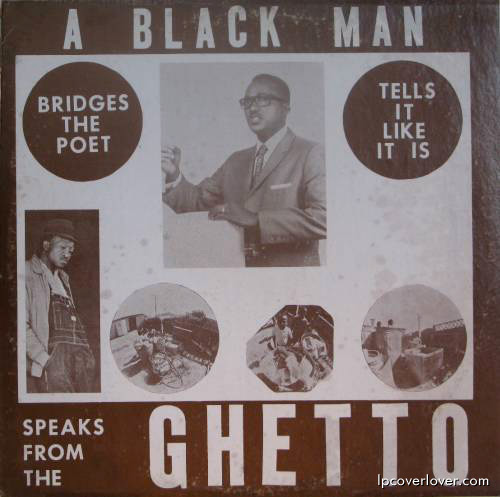
“A Black Man Speaks From the Ghetto”     Preachin’ and teachin’ in the ghetto.

1 Star2 Stars3 Stars4 Stars5 Stars (21 votes, average: 3.00 out of 5)
Loading ... Loading ...

Blues and Haikus

_1239.JPG

42.JPG

Jack Kerouac with jazz greats Zoot Sims and Al Cohn. (1958). His second album on Hanover after “Poems for a Beat Generation” on which he was accompanied by TV talk show host Steve Allen. Produced by Bob Thiele. Click on the back cover here and hopefully you can read the liner notes by Gilbert Millstein. Kerouac calls Zoot and Al “Holy Blakean babies” and says “Zoot and Al blow thoughtful, sweet metaphysical sorrows.” Kerouac actually sings on one cut with Zoot playing piano for the first time on record. Here’s one of the haikus: “In my winter cabinet/the fly has/died of old age” Beat that.

Track listing: American Haikus; Hard Hearted Old Farmer; The Last Hotel & Some Of The Dharma; Poems from the Unpublished Book of The Blues; Old Western Movies; Conclusion Of The Railroad Earth.

Hear some of this record HERE.

1 Star2 Stars3 Stars4 Stars5 Stars (41 votes, average: 4.49 out of 5)
Loading ... Loading ...

Famous busts

img_0506.JPG

Jayne Mansfield: “Shakespeare, Tchaikovsky & Me” MGM Records. (1964) Jayne recites Shakespeare’s sonnets and poems by Marlowe, Browning and Wordsworth against a background of Tchaikovsky’s music.

Opening / How Do I Love Thee / The Indian Serenade / Good Night / You Say I Love Not / If This Be Love / The Lady’s “Yes” / She Walks In Beauty / Cleopatra / Was This The Face / Whiteness, Or Chastity / Madrigal / Jenny Kiss’d Me / Verses Copied From The Window Of An Obscure Lodging House / The Enchantment / The passionate Sheperd To His Love / Upon The Nipples Of Julias Breast / Drink To Me Only With Thine Eyes / The Lovers / To the Virgins, To Make Much Of Time / Inclusions / When You Are Old / Daffodils / Take, O, These Lips Away / Mark How The Bashful Morn / Oh! Dear, What Can The Matter Be? / The Millers Daughter / The Fire Of Love / The Constant Lover / Why Should A Foolish Marriage Vow / Believe Me, If All Those Endearing Young Charms / Love Me Little, Love Me Long

The New York Times described the album as the actress reading “30-odd poems in a husky, urban, baby voice”. The paper’s reviewer went on to state that “Miss Mansfield is a lady with apparent charms, but reading poetry is not one of them.”

1 Star2 Stars3 Stars4 Stars5 Stars (26 votes, average: 3.85 out of 5)
Loading ... Loading ...
Weary blues

img_4182.JPG

“Did You Ever Hear The Blues?” BIG MILLER (1922-1992) does “deep blues” by Langston Hughes. United Artists.

Clarence Horatio Miller’s first influence in music came from his father’s church but he also heard the blues sung by men working on the railroad. In the 30s, while still a student, he formed a band, but with the outbreak of World War II he joined the army. After serving in the Pacific and in Europe, he began entertaining his fellow soldiers. In 1949 he joined Lionel Hampton’s band, then had a five-year spell with Jay McShann. Miller had a commanding style and his rich voice lent itself especially well to the material he favoured. His influences in the blues were Joe Turner, Jimmy Rushing, T-Bone Walker and Jimmy Witherspoon, whom he followed into the McShann band. He also admired the ballad style of Billy Eckstine. Miller’s abiding interest in the blues was such that writer-poet Langston Hughes wrote a series of songs especially for him.

Langston Hughes (1902 – 1967) published more than three dozen books during his life, starting out with poetry and then expanding into novels, short stories, and plays. He is closely associated with the Harlem Renaissance, the flowering of African-American literature and music in New York City following World War One, but he wrote poetry, books, and newspaper columns right through into the 1960s. Hughes’s work often spoke plainly about the lives of ordinary black people, which in later years earned him a reputation as one of the major black voices of the 1900s. His works include the poetry volumes The Weary Blues (1926) and Shakespeare in Harlem (1942), the novel Not Without Laughter (1930), and the short story collection The Ways of White Folks (1934). He wrote two personal memoirs: The Big Sea (1940) and I Wonder as I Wander (1956).

1 Star2 Stars3 Stars4 Stars5 Stars (14 votes, average: 4.71 out of 5)
Loading ... Loading ...