Feat of Clay

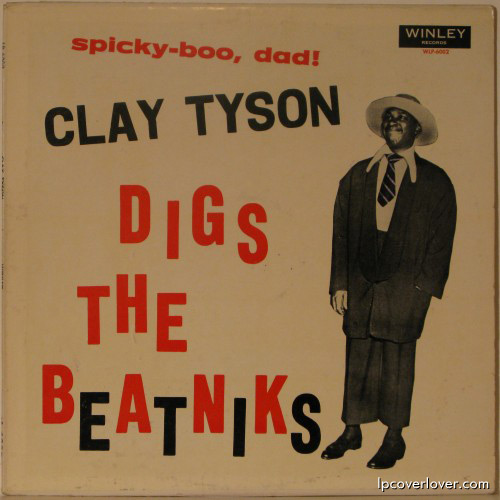
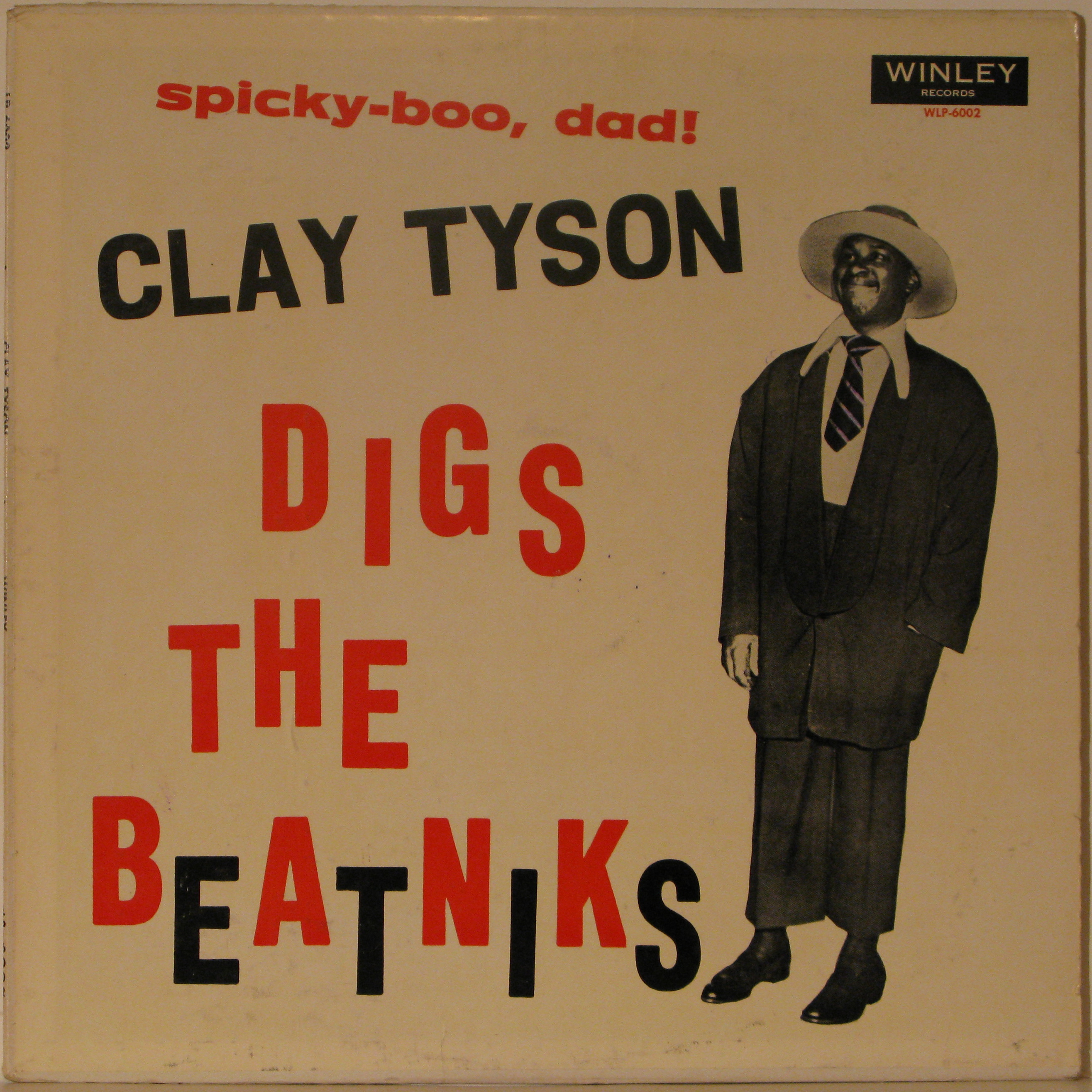
Clay Tyson “Digs The Beatniks” “Spick-boo, dad! Winley Records (Check out his zoot suit!)
You are currently browsing the archive for the Beatniks category.

Clay Tyson “Digs The Beatniks” “Spick-boo, dad! Winley Records (Check out his zoot suit!)

Max Bygraves “Nursery Rhymes For Grown-Ups. Decca (Australia) Forgive me these other title considerations from a list of classic nursery rhymes:
All Around the Mulberry Bush / Bum, Bum, Baily O! / Dickery Dickery Dare / Diddle, Diddle, Dumpling / Hart He Loves the High Wood / Here We Go Round the Mulberry Bush / Hey Diddle Diddle /Hokey Pokey / Hot Cross Buns / Humpty Dumpty / I Had a Little Nut Tree / I Love Little Pussy / Peter, Peter, Pumkin Eater / Peter Piper / POP! Goes the Weasel / Ride a Cock Horse / There Was A Crooked Man / This Little Piggy Went To Bed / Wee Willie Winkie or maybe Where is Thumbkin?


“Beat Generation” Jazz Poetry. Folk Lyrics. John Brent, Len Chandler and Hugh Romney at the Gaslight, Greenwich Village. Musitron Records.

“Campus Capers” In “Cool Fidelity”. I have a second volume of the same name. I love these cool beatnik era illustrations.


“Grimm’s Hip Fairy Tales” As Dug by Don Morrow. Roulette Records. This notion of “updating” the classics (from Shakespeare to Fairy Tales to TV commercials, even the bible) with jive talk and hipster lingo was done numerous times by performers like Lord Buckley, Del Close and DJ Al “Jazzbo” Collins (Who also released a beatnik version of these familiar stories – “Grimm Fairy Tales for Hip Kids”.)
Jack Kerouac with jazz greats Zoot Sims and Al Cohn. (1958). His second album on Hanover after “Poems for a Beat Generation” on which he was accompanied by TV talk show host Steve Allen. Produced by Bob Thiele. Click on the back cover here and hopefully you can read the liner notes by Gilbert Millstein. Kerouac calls Zoot and Al “Holy Blakean babies” and says “Zoot and Al blow thoughtful, sweet metaphysical sorrows.” Kerouac actually sings on one cut with Zoot playing piano for the first time on record. Here’s one of the haikus: “In my winter cabinet/the fly has/died of old age” Beat that.
Track listing: American Haikus; Hard Hearted Old Farmer; The Last Hotel & Some Of The Dharma; Poems from the Unpublished Book of The Blues; Old Western Movies; Conclusion Of The Railroad Earth.
Hear some of this record HERE.
“Bailando con Billy” Columbia Records. Billy Cafaro con Lucio y Su Conjunto. Billy looks a lot like Maynard G. Krebs
Lenny Bruce – American Fantasy Records 7011. Selections recorded in 1960 during nightclub performances in San Francisco.
Liner Notes by Ralph J. Gleason:
If there is one single theme running through the New Comedy of Dissent, it is that an agonizing reappraisal of the priorities of our society is overdue. Artists are on the picket point of all social movements and the jazz men and the satirical creative comics have been the picket points in this country ofthe great social upheaval that has shaken the entire world in the decade following World War II.
Let us not confuse the jazz musicians of the interregnum between the World Wars with the jazz musician now; the attitudes and assumptions are entirely different. The jazzmen of the 30′s, no matter how iconoclastic and no matter how rebellious, accepted as a working base the stereotype his audiences wanted.
The comedians were no less bound by ritual and by rote. World War II broke this and freed the colonial peoples of the world from their concept of subservience and this has been reflected in the jazz musician and it also shook up The Establishment sufficently so that parts slintered off and a reassessment began. Today’s dissent is not based on revising the same order of things but upon a complete re-examination and a completely new approach which abandons the pose and the pretense that had become traditional.
Comedy – especially improvised, creative comedy – bears a strong resemblance to jazz. It is rooted in the same dissent, nurtured in the same rebellion and articulated in the same language in which the priorities of the Establishment have no standing at all.
There is no better example available on record of this entire attitude than Lenny Bruce’s bit on “How to Relax Your Colored Friends at Parties” on this LP.
Done before a mixed audience, the reaction is mixed. Some non-Negroes are outraged either because they think the attitude is outrageous or because they are ashamed to have the truth so bluntly put. Others are momentarily shocked but then, as they see themselves in past moments portrayed on stage they laugh embarrassedly. Others – those few who have escaped from the chains of race to some degree – fall out.
The same spectrum of reaction is followed by the Negroes in the audience. The more courageous and the freer dig it immediately and respond. Then there are those who fear it will rock the boat inhibits them.
Thus it is with Bruce’s humor in many areas. Comedians divide in their reactions. Any of them, from the bland Bob Newhart to the salty Mort Sahl who are themselves based on the same assumptions of paradox and pretense, go down the line with him. Like Charlie Parker, Bruce’s humor is the seminal influence of his generation and a decade from now its effects will be so widespread that those influenced by it may not even be aware of it.
Bruce has already opened up new areas for other comics to explore and it is a testament to the artistic density of the structure of his art that it is so rewarding line by line and concept by concept. Any Bruce show disgorges countless asides and inferences and quick bits that can be expanded (and are being expanded) by others. Bruce has opened the door to a reconsideration of everything in our society except the basic truths of love and beauty and honesty and truth itself. He is, in essence, attacking the whole of our society from the point of view of a street-wise primitive Christian preacher. In other words, he is the child who says the Emperor has no clothes.
There are several other points which are useful to keep in mind when listening to Bruce. He, like the jazz musician, gets bored with the same routines and this has led him to improvisation and leads him now away from things which have become associated with him, making his nightly shows a different experience than his records. He may very possibly do none of the bits on this album any longer. He may probably be bored with them.
The relationship between Bruce and the jazz musicians extends into something else, too. The jazz audience is the basic audience for Bruce because jazz listening postulates familiarity with the feeling of improvisation and this is essential to understanding and appreciating Lenny Bruce. He “wails” like a jazz man, “get in the groove” or whatever he may use to describe the jazz musician’s equivalent of being “on.” You throw away the openings sometimes because he’s just getting started. And when he is in the groove, wailing and on, the whole thing swings in a jazz sense.
One other point. The New Comics, Bruce in particular, establish a very personal relationship with their audience by the simple process of extending their own intimate circle to include the audience. The audience are all personal friends. “I have to read newspapers and see TV shows so I can come back and tell YOU about them,” Bruce remarks to the audience. His entire attitude is that of the gifted commentator in the personal circle telling all his friendsabout the incredible examples of life and social behaviour he has encountered in the recent past. He does not tell jokes. He does bits and he does routines, but he also tells them directly to YOU. This is both the secret of the successand the failure of this form of the comic art. But at its best, it is somethingmore vital and alive than anything except the very best in art. Some excerpts of that order are included here.

Mario Albanese “Insonia” (“Insomnia”). Odeon from Brazil (1959). Courtesy of LP cover lover Desiderio (Julio Siveira). Loronix has this posted with a link to download the music! Check it out.