Frank Zappa and The Mothers of Invention. Recorded 1967-1969. Bizarre Record Label. Released 1970.
Frank Zappa recruited artist Neon Park to create a subversive image based on a cover story from the September 1956 issue ofMan’s Life, a men’s adventure magazine. After showing Neon a copy of the magazine, Zappa inquired, “This is it. What can you do that’s worse than this?”Neon’s answer was to craft a parody of an advertisement for Schick brand electric razor based on the “Weasels Ripped My Flesh” theme.
Conceptually, the album could be considered phase two of Burnt Weeny Sandwich. Both albums consist of previously unreleased Mothers tracks released after the demise of the original band. Whereas the pieces on Burnt Weeny Sandwich generally have a more rigid and planned feel captured by quality studio equipment, Weasels Ripped My Flesh mostly captures the Mothers on stage, where they employ frenetic and chaotic improvisation characteristic of avant-garde free jazz. – Wikepedia
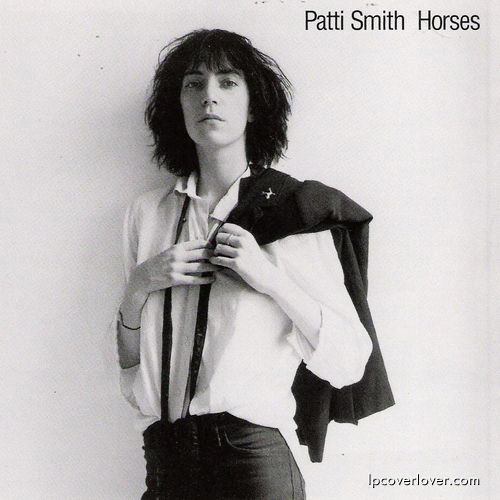
HORSES Patti Smith Arista, 1975 Designer: Bob Heimall Photographer: Robert Mapplethorpe
I’ve always taken great pictures of Patti Smith,” said Robert Mapplethorpe in 1987. He described the collaboration as “like taking drugs; you’re in an abstract place and it’s perfect.” The cover of Smith’s cataclysmic debut LP, Horses, is the most celebrated document in the relationship between the photographer and the poet-songwriter, which spanned two decades. Mapplethorpe shot the cover to Smith’s album Dream of Life not long before his death in 1989.
The two met when Mapplethorpe was an art student and Smith wandered into his Brooklyn apartment looking for someone else. In 1970 they moved to Manhattan’s legendary Chelsea Hotel, where they shared the smallest room because it was all they could afford. “We used to stay up all night,” Mapplethorpe said, “and she would do her thing and I would do my thing, and then we’d take a break and smoke a cigarette and look at each other’s work.” That intimacy informs the Horses portrait: The directness of Smith’s gaze plays against the tense shyness of her stance; the androgyny of her dress counters the elegance of her fingers. The cover mirrors the intensity and sparse clarity of Smith’s music.
>In 1988 the catalog to a controversial Mapplethorpe retrospective included a poem by Smith that captures perfectly the exploratory essence of both Horses and Mapplethorpe’s photo. “The Artist machetes a clearance,” she writes. “Here one can be spared/the pain and extravagance of the entire body and/be transported by snaking thru a glittering fraction.”
Near legendary New York poetess and songstress comes up with an almost free-form rock set that is much much better than one might have expected. Produced by John Cale, the set comes closest to catching the urgency and sheer energy of the early Velvet Underground since the emergence of that group. Smith’s interesting and totally unique talk/sing song makes this set the most accessible LP of its type yet for those who do not feel at home with this type of material, and there are guest stints from Tom Verlaine and Allen Lanier. Frantic and frenetic instrumentation behind Smith’s vocals also work well. A truly powerful effort that offers the listener something new for a change. Best cuts: “Gloria (the old Them hit),” “Free Money,” “Kimberly,” “Land,” “Elegie. – Billboard,1975.
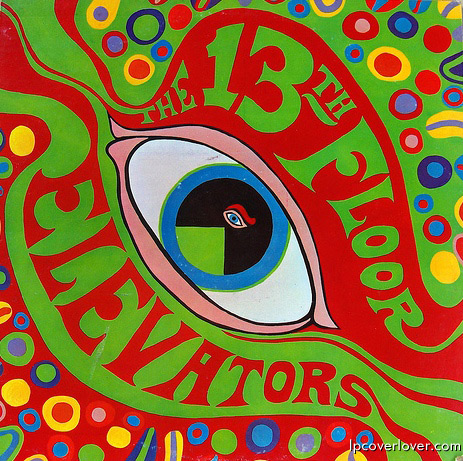
The 13th Floor Elevators formed as a band in Austin, Texas in late 1965. Tommy Hall, a University of Texas philosophy/psychology student, had been experimenting with psychedelics and playing the jug in a folk band. Hall came up with the unique idea of placing a microphone next to his jug which created a very unusual sound. He could see that combining his electric jug with psychedelic lyrics opened up a strange new territory, and Hall recruited several additional musicians from a Port Aransas-Rockport area group called the Lingsmen: Stacy Sutherland (lead guitar), Benny Thurman (bass), and John Ike Walton (drums). The final link was Roky Erickson.
Erickson was seventeen when he had written and released a local Top Ten single with The Spades (August 1965/zero Records) called “You’re Gonna Miss Me.” He was an accomplished rhythm guitar player with a powerful voice, and The Elevators signed with a Houston record company called International Artists. “The Psychedelic Sounds of the 13th Floor Elevators” was released in August 1966, and the song “You’re Gonna Miss Me” eventually reached #56. The album also included such psychedelic songs as “Roller Coaster,” “Kingdom of Heaven,” “Reverberation (Doubt),” and “Splash 1.”
Before a second album had been attempted, internal friction and drug problems forced the departure of John Ike Walton and Benny Thurman. Replacements were found in Danny Thomas (drums) and Ronnie Leatherman (bass) although Leatherman only lasted until July 1967 to be replaced by Danny Galindo. This unit entered the studio for two months to cut the worthy follow- up album Easter Everywhere (Sept. 1967). It contained an eight minute poem “Slip Inside This House” as well as “Postures (Leave Your Body Behind)” and a cover of Dylan’s “Baby Blue.”
The Elevators did a good deal of touring that included an appearance on the Dick Clark show. When the Elevators had finished their song, Dick Clark innocently asked Roky, “Who is the head of the band?” Roky’s response was, “We’re all heads.”
The Elevators were having a rough time of it in Texas as they were constantly in trouble with the police and the Texas Rangers. The penalty at that time for being caught with one joint was twenty years in jail. The first time the Elevators were busted they were not prosecuted due to a technicality, but a second bust occurred at a state university with Roky being ordered to stand trial. The defense attorney decided a plea of insanity (based on Roky’s altered state) would be less harsh for his client, but the result was a five year sentence. Roky would spend the next three and a half years at a mental institution called Rusk State Hospital.
The Elevators, without Roky who was their figurehead and unofficial leader, were finished. International Artists tried to capitalize on what success the Elevators had by releasing The 13th Floor Elevators Live album (January 1968) which was essentially studio outtakes that were overdubbed with phony cheering and applause. The last Elevator album to appear was Bull of the Woods (December 1968) that was primarily the effort of Stacy Sutherland.
The Elevators tried to get back together several times after Roky’s release, but an ongoing feud between Roky and Tommy never seemed to get resolved. The death of Stacy Sutherland (killed in a domestic squabble with his wife in 1978) confirmed the Elevators existence was officially over.
Except for a bizarre single called “Red Temple Prayer (Two-Headed Dog)” that was released in 1975, Roky’s sabbatical would last thirteen years. Roky Erickson returned with the 1980 album based on B-grade horror movie material called Roky Erickson and the Aliens (August 198O/CBS-U.K.) It was produced by Stu Cook (ex-bass player for Creedence Clearwater Revival) and included such songs as “Creature with the Atom Brain,” “Cold Night for Alligators,” “Stand for the Fire Demon,” and “I Walked with a Zombie.”
Roky continued to make several more interesting albums throughout the 1980s, but his mental condition seemed to be deteriorating. Then in 1989 he was charged with the federal crime of tampering with the U.S. Mail—apparently he collected mail for an apartment complex and never gave it to the addressees. Consequently, he went to court where the judge did not believe that Roky had a mental condition and had him sent to Missouri for “testing.” At some point in the process, Roky snapped.
Ace recording artist Huey “Piano” Smith hit the top of the R&B charts with the classic “Rockin’ Pneumonia and the Boogie Woogie Flu.” A double sided classic “Don’t You Just Know It” b/w “High Blood Pressure” was released the following year.